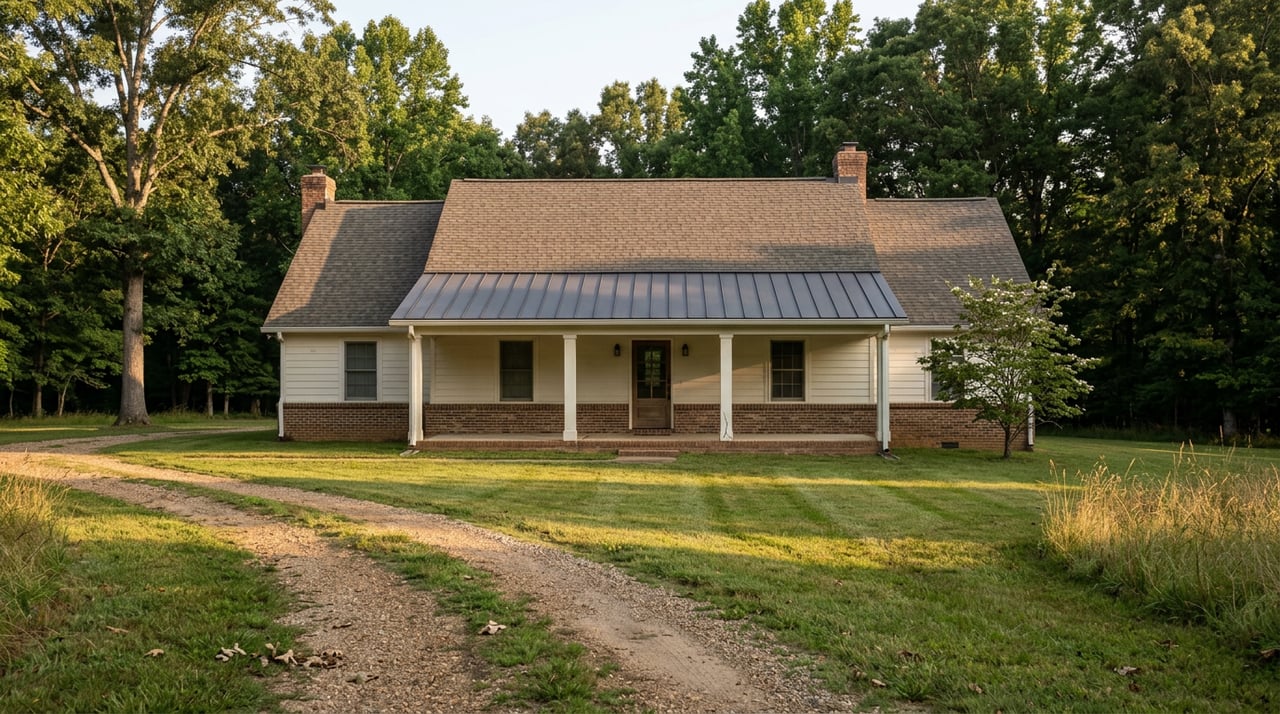
Two homes sit on Hundley Place in Leber Estates, the Hanover County subdivision carved into 19 lots ranging from five to eleven acres, just five minutes from I-295. One is listed at $779,900: the Lynn floor plan, 2,748 square feet, three bedrooms, two baths. A few doors down, on the same paved private road, with the same builder connections and the same "five minutes from I-295" pitch, another finished home lists at $1,148,793, with four bedrooms and three and a half baths.
That's not a small gap. It's nearly $369,000 between two houses that share a subdivision name, a road, and a marketing pitch. Extra bedrooms and bathrooms explain part of it, but not all of it, and that's the part worth understanding before you fall for the acreage.
The land isn't the product. The lot is.
Search results for Leber Estates read like every other rural new-construction listing in the region: paved roads, high-speed internet, deep wells, five to eleven acre homesites. What those listings don't say clearly is that Leber Estates isn't one product sold by one company. Two separate listing descriptions for homes in the subdivision mention that buyers can choose from three different builders working the same 19 lots. That single detail changes how you should shop here.
When one builder controls an entire subdivision, the floor plans, the specs, and the pricing structure usually hold together in a way you can compare lot to lot. When three builders are each buying and building on their own parcels inside the same 19-lot footprint, you're not comparing houses inside one market. You're comparing three small businesses, each making its own decisions about site work, foundation type, well depth, and septic design, and each pricing accordingly. The address says "Leber Estates" on all of them. The cost basis underneath the dirt does not match.
What a five-to-eleven acre lot actually requires
Every home in Leber Estates runs on a private well and a septic system, because there's no county water or sewer line reaching lots this far out. That's standard for rural Hanover County acreage, and it's also where a lot of the price spread actually lives.
A private well in Virginia typically runs $5,000 to $15,000 depending on how deep the driller has to go and what the geology looks like underneath a given lot, according to a Virginia-specific well guide. Septic costs vary even more. A straightforward gravity-fed system on cooperative soil can run $8,000 to $20,000. A lot with poor drainage or heavy clay can require an engineered or alternative system, and those run higher, sometimes well past $50,000 once you include design, soil evaluation, and installation. Virginia requires both a well construction permit and a septic permit through the local health department before any of this work happens, and the septic side specifically requires a soil evaluation from a licensed Authorized Onsite Soil Evaluator before a design gets approved.
Here's the part that doesn't show up on a listing sheet: two five-acre lots sitting a quarter mile apart in the same subdivision can have completely different soil profiles. One passes a standard percolation test and gets a conventional system for around $15,000. The other has clay-heavy ground that fails the same test and needs an engineered system that costs three times as much, before a single stud goes up. Neither lot looks any different in a photo. Both get marketed as "5-11 acre homesites." The buyer never sees the difference until the builder's site costs show up in the final number.
RCI builds the same house at five different price anchors
RCI Builders, the Mechanicsville company founded in 1999 by Todd Rogers and Mike Chenault with Patrick Ashley joining as a third owner in 2012, doesn't just build in Leber Estates. The same Wilton floor plan sold in Leber Estates shows up again in Sheppards Fold. The same Creekwood plan sold in Leber Estates shows up again in Shady Grove Park. The same Lynn plan sold in Leber Estates shows up again in Dunham Farms. One builder, a small set of repeating floor plans, and a ladder of rural communities that differ almost entirely by lot size. Lining those communities up side by side shows how much of the price is really the acreage tier, not the house:
| Community | Typical Lot Size | Positioning |
|---|---|---|
| Santee Farm | 1 acre | Estate-style lots along Old Church Road |
| Sheppards Fold | 1.3 to 1.6 acres | Wooded acreage in the Scotchtown corridor |
| Leber Estates | 5 to 11 acres | Three builders, deep wells, paved roads |
| Rock Creek | 6 to 8+ acres | Country living near the Atlee corridor |
| Spring Run Estates | 10 to 11 acres | Coming soon off Spring Run Road |
The floor plans repeat across this list. The acreage doesn't. When a builder can offer the same Lynn plan at multiple price points depending on which community it sits in, the acreage tier is functioning as the real pricing lever, not a bonus feature layered on top of a fixed home price. A buyer comparing "price per square foot" between Leber Estates and a standard half-acre Mechanicsville subdivision is comparing two different cost structures wearing the same unit of measurement.
Why the price-per-square-foot comparison breaks down
If you're cross-shopping Leber Estates against a sewered subdivision closer to town, the instinct is to divide price by square footage and call it a day. That math ignores everything sitting underground. Rural construction costs in Hanover County run in the neighborhood of $180 to $255 per square foot once well and septic systems are factored in, a range that includes site work a comparable subdivision lot with municipal water and sewer never has to absorb. A three-bedroom home on a half-acre lot in town and a three-bedroom home on five acres in Leber Estates can carry the same square footage and finish level and still land tens of thousands of dollars apart, because one of them paid for a well, a septic system, a soil evaluation, and a longer driveway before the framing crew ever showed up.
None of this means acreage is a bad trade. It means the premium you're paying for privacy and space isn't a flat markup. It's a bundle of site-specific costs that vary by lot, by soil, and by which of the three builders happens to hold that particular parcel.
What to ask before you write an offer
If a Leber Estates lot has your attention, a few questions do more for you than the listing photos ever will:
- Has this specific lot completed a percolation test, and what type of septic system did it qualify for?
- What is the estimated well depth for this lot, based on nearby wells already drilled in the subdivision?
- Which of the three builders holds this parcel, and what does their standard site-work package include versus what's billed as an upgrade?
- Are the well and septic permits already issued through the county health department, or still pending?
- How does the base price compare to a similar floor plan this same builder is offering in one of its other acreage communities?
Getting straight answers here tells you more about the real cost of a specific lot than any square footage comparison will.
A few questions buyers ask before touring Leber Estates
Does every home in Leber Estates need its own well and septic system? Yes. The subdivision sits outside county water and sewer service, so every lot relies on a private well and an individually permitted septic system, both requiring approval through the local health department before construction.
Why would two homes on the same street cost such different amounts? Bedroom and bathroom count explain part of it, but the larger driver is usually what sits underground and which builder holds the lot. Soil conditions affecting septic design, well depth, and site-specific costs vary lot to lot even within one subdivision, and those variables move the price more than the floor plan does.
How long does the well and septic approval process usually take? General Virginia guidance puts the timeline at four to eight weeks from the first call to a licensed driller to a potable water test result, with permit review and lab testing usually accounting for the longest stretch. Septic approval runs on a similar track once a soil evaluation is complete.
If you're weighing a five-acre lot in Leber Estates against a smaller lot closer to town, the acreage isn't the whole story and the listing price isn't either. Renee Cowan has spent 30 years walking Hanover County buyers through exactly this kind of comparison, the kind where the real numbers live underground and nobody hands them to you upfront. Work with us before you write the offer, not after the perc test comes back.